 Expert Irrigation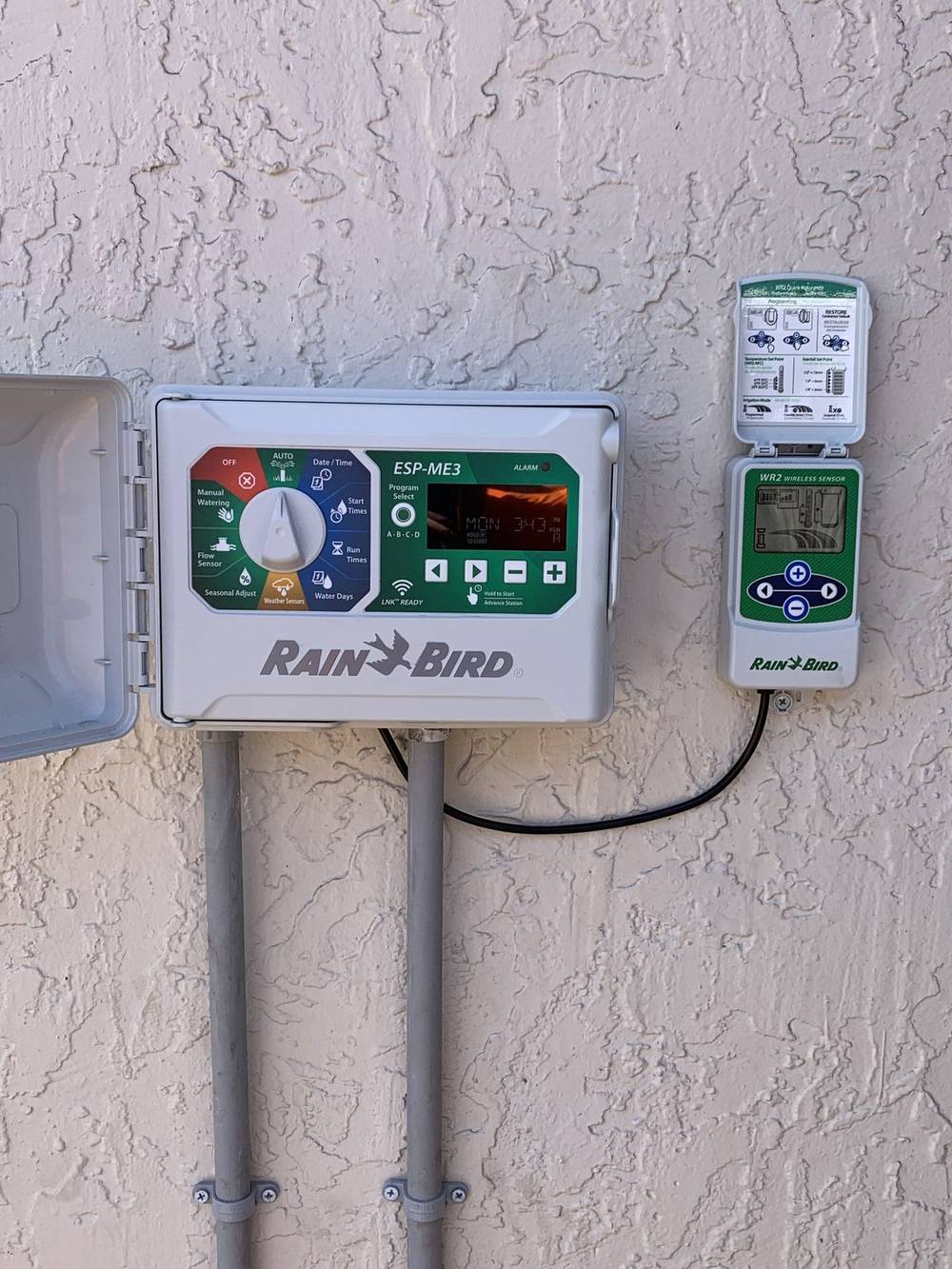
Most irrigation controllers in Broward were programmed once, on the day they were installed, and never touched again. UF/IFAS research puts the resulting over-irrigation at sixty to seventy-eight percent. That is water you are paying for, running during months when the lawn does not want it.
The problem a fixed schedule cannot solve
UF/IFAS publishes recommended run times for South Florida month by month, and the numbers move substantially across the year — peak demand in the height of summer heat, and a deep trough in October when rainfall runs well ahead of evaporation. Your lawn's water requirement in April is nothing like its requirement in October. A controller set to one schedule is wrong for at least nine months of the year, and it is wrong in the expensive direction.
What a smart controller actually does
It adjusts run time automatically against local weather data or soil moisture, while still respecting your assigned watering days. It will not water the morning after two inches of rain. You can check and change it from your phone, which matters more than it sounds — it means the schedule actually gets adjusted when something changes, instead of never.
There is also a regulatory angle worth knowing: Broward County notes a possible exception to the standard restrictions for systems using a smart controller with a soil moisture sensor covering more than half of an irrigated zone. That is not a blanket exemption and it is worth confirming with your utility before relying on it, but it exists.
Rain sensors
Florida Statute 373.62 requires anyone operating an automatic irrigation system to properly install, maintain, and operate a device that shuts the system down during sufficient moisture. Nearly every system we open has one, and most of them are dead — mounted under an eave where rain never reaches them, or with expanding disks that dried out and crumbled years ago. The disks need replacing at least every two years and the sensor needs testing annually. Set the threshold to an eighth of an inch, the lowest most units allow.
Being straight about the evidence: under controlled conditions, expanding-disk rain sensors have shown seventeen to thirty-four percent water savings, but UF/IFAS also notes that in real-world practice they often have not reduced excess irrigation much — because they are installed wrong, positioned wrong, or long dead. A sensor that is actually maintained is a different proposition from one that is merely present.
What we install
We work with the mainstream smart platforms and will recommend based on your zone count, whether you have Wi-Fi coverage at the controller location, and whether you want soil moisture sensing or weather-based scheduling. Broward controllers live outdoors in heat, humidity and salt air, so enclosure quality and surge protection matter as much as the app does. We install surge protection on every controller we replace — lightning taking out a controller and its solenoids is a routine summer event here, and a fifty-dollar precaution is cheaper than the callback.